Skullcandy Crusher Evo vs Crusher ANC 2
Amazon links in this article are affiliate links. As an Amazon associate, I earn from qualifying purchases.
The Skullcandy Crusher Evo and Crusher ANC 2 are easily two of the most bass-heavy headphones on the market. Nothing else I’ve tested comes close in terms of sheer bass quantity.
Differences – Quick Summary
Crusher Evo (left) and Crusher ANC 2.
If you just want the short version:
Crusher ANC 2
Better overall driver tuning
Deeper sub-bass extension
Multi-point Bluetooth (connects to two devices)
Active Noise Cancellation (ANC)
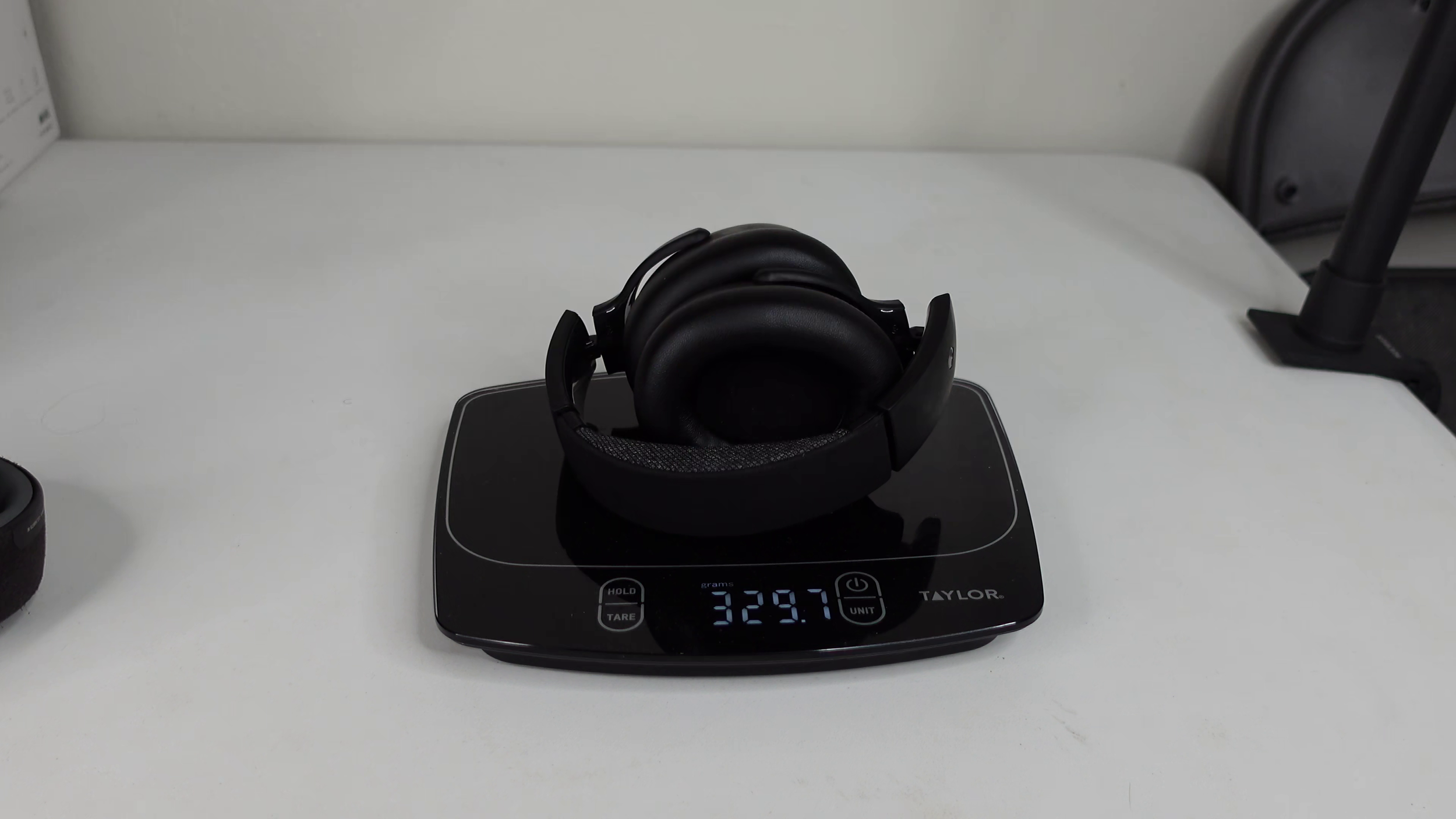
Heavier at ~330 g
Thicker, more comfortable padding
Crusher Evo
Stronger, more aggressive bass vibration
No ANC
No multi-point Bluetooth
Lighter at ~314 g
Bass Arena Recommendation:
While the Crusher Evo hits harder, the Crusher ANC 2 sounds better overall and delivers better bass extension. I recommend the Crusher ANC 2.
Connectivity, Battery Life, and Controls
Crusher Evo
Bluetooth: 5.0. No multi-point
Battery life: Rated 40 hours. Real-world battery life matches (or slightly exceeds) Skullcandy’s claims
One major downside: no auto shut-off, which can drain the battery if you forget to power it down.
Controls include:
Volume up (hold to skip forward)
Play / pause
Volume down (hold to go back)
Power button
Physical Crusher bass slider (finite scroll, holds position well)
Crusher ANC 2
Bluetooth: 5.2
Multi-point pairing: Yes (audio from one device at a time)
Battery life: Rated 60 hour.
Again, there is no auto shut-off, which is the single biggest battery issue. In real use, battery life depends heavily on remembering to turn them off.
Controls are similar:
Volume up / down (media skipping via long press)
Play / pause
ANC switch (ANC on / off / Stay Aware)
Power button
Infinite scroll Crusher bass slider (adjustable via app)
Headphone Audio Quality
Bass
You want bass? You got it.
The Crusher system works by using dedicated haptic drivers that physically vibrate the headphones, and the slider controls how much of that bass you both hear and feel.
Crusher Evo (left) and ANC 2.
In the original Crushers from 2013, this effect felt more like a game controller rattling around your head. With the Evo and ANC 2, that sensation is far more refined, but the two models still approach bass very differently.
On the Crusher Evo, the bass is extremely aggressive and immediately noticeable. It’s a boomy, thumpy presentation that mimics the feeling of standing next to large club subwoofers. It’s a lot of fun, but it can get out of control quickly. Indoors, I usually keep the Crusher slider around 20%. Outdoors, I’ll push it higher, but once you get past roughly 60%, it stops feeling like bass and starts feeling like pure vibration and rattling.
Crusher ANC 2 on my miniDSP EARS measurement rig.
The Crusher ANC 2 doesn’t hit quite as hard with its haptics. Compared directly, it reaches about 60–70% of the Evo’s intensity. However, what it lacks in brute force, it makes up for with noticeably better bass extension (see the graphs below). Instead of feeling like a forceful shake, the bass comes across as a deeper, more natural rumble. It integrates better with the rest of the sound.
Driver Tuning and Overall Sound
(Frequency response measurements taken with my miniDSP EARS. Not industry standard.)
Both headphones use 40mm dynamic drivers that are separate from the Crusher haptics. With the Crusher slider set to 0%, you’re hearing the raw tuning of those drivers — and honestly, this is where both headphones struggle.

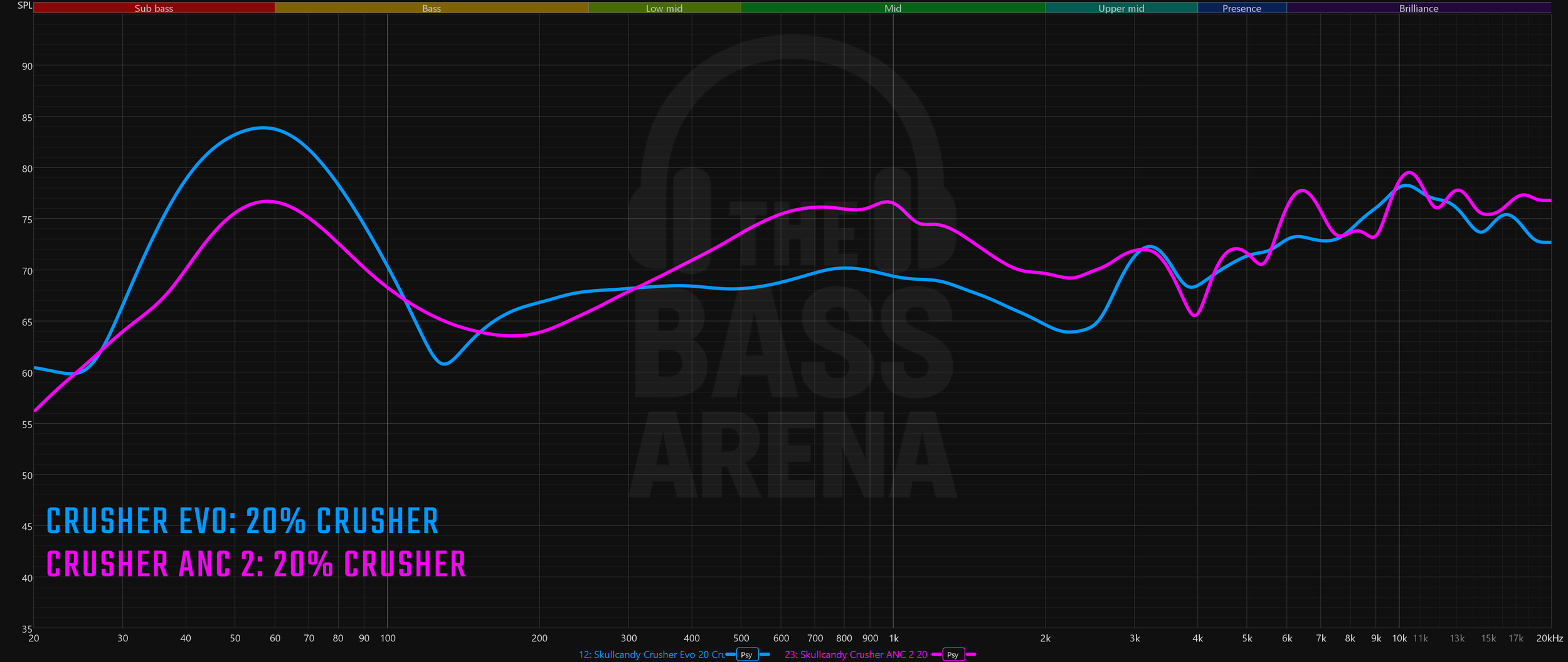
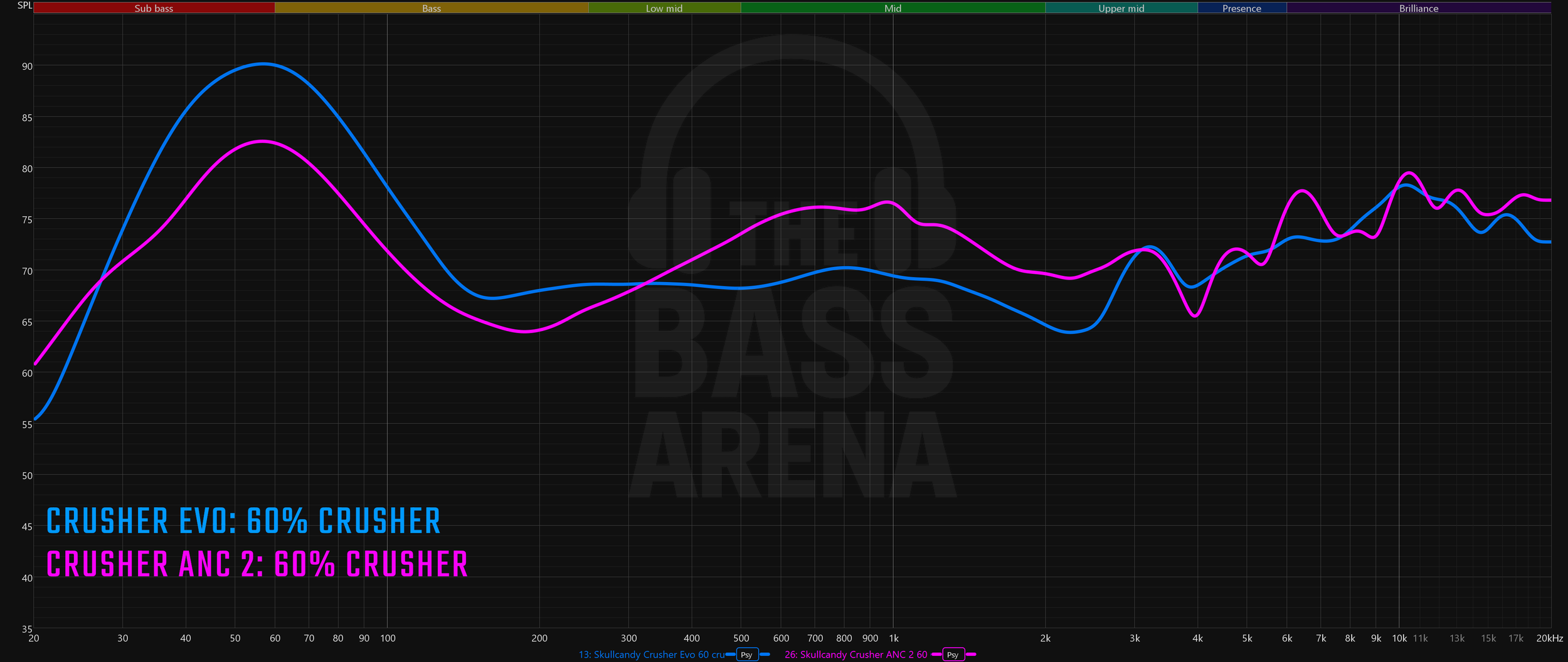
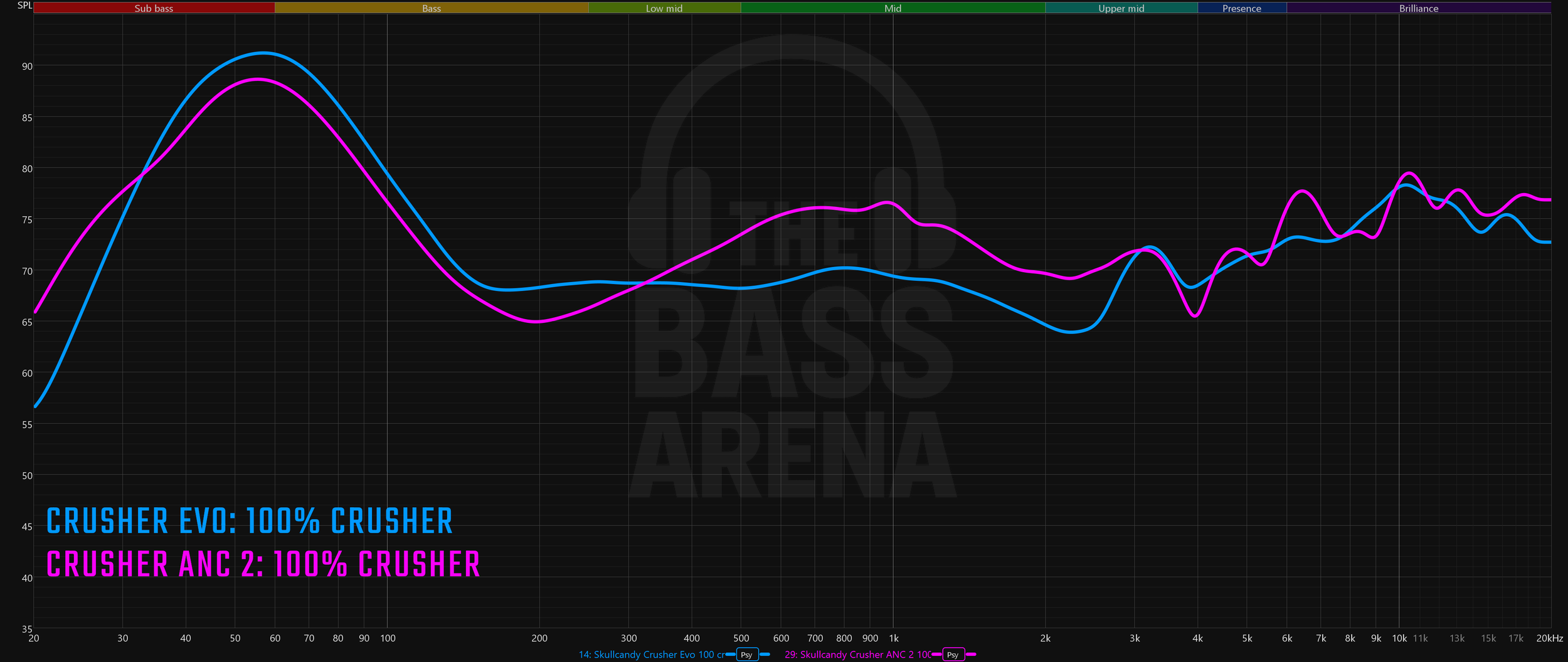
The Crusher Evo was measured using the “music” preset, and the Crusher ANC 2 was measured using a custom preset set to flat.
With Crusher disabled, neither of these headphones sounds particularly good. The bass is weak, the sub-bass is almost nonexistent, and the treble is the most prominent part of the frequency response.
On the Crusher Evo, vocals sound thin and somewhat shrill. Female vocals in particular can become sibilant, and there’s very little body to music overall. Even after owning the Evo for years, I’ve never liked this baseline tuning.
The Crusher ANC 2 does improve things slightly. There’s more midrange presence which gives vocals a more natural tone, but there’s still a lack of weight in the lower mids and bass. Media in general feels lighter than it should, and once again, the treble remains the dominant frequency range.
Once Crusher is enabled, even at just 20%, both headphones receive a massive bass boost that no traditional headphone tuning comes close to. However, this boost is concentrated in a relatively narrow frequency range. There’s still a noticeable drop-off below about 35 Hz on both, and the upper bass and lower mids don’t receive the same level of reinforcement. The range of the bass boost is still far wider on the Crusher ANC 2.
As you increase the Crusher level to 60% and beyond, the effect becomes extreme. At 100%, you feel the bass more than you hear it. It’s insanely fun at first, but over time you start to notice the limitations. Instead of a warm, rich sound, you end up with two competing layers: the main drivers and the haptic bass system.
That said, I love the unique (and patented) approach Skullcandy has taken in regards to bass. Despite the flaws, the experience is still unique and wildly entertaining.
Overall, the ANC 2 is better tuned than the Evo, but neither headphone sounds complete without Crusher engaged.
Microphone Quality
The Crusher Evo’s microphone is serviceable, but it has a few issues. There’s some noticeable electronic feedback, and it picks up a lot of background noise. Tonally, it’s above average.
The Crusher ANC 2’s microphone is significantly better for calls, but the processing is a bit much. It uses a noise gate that cuts out background noise when you stop speaking. While I generally prefer noise rejection over aggressive gating, it works well here. When you are speaking, it does a solid job reducing background noise, and the tonality is warm and clear without sounding too muffled. For a Bluetooth headphone mic, it’s well above average.
Software (Very Briefly)
This section is short for a reason: the software is bad.
The Crusher Evo uses the Skullcandy app, which offers no real EQ control — just a few presets that don’t sound great. There’s no flat preset, and you have to reconnect the headphones to the app every time you use them. And there’s no guarantee it will even work properly. No custom EQ is reason enough to get the ANC 2 over the Evo.
Crusher Evo EQ Presets.
Crusher ANC 2 with real EQ.
The Crusher ANC 2 uses Skull IQ which at least includes a real 5 band equalizer, Crusher bass adjustment, and ANC controls. Unfortunately, you’re limited to only one custom preset, and the app frequently forgets the headphones entirely. Re-pairing resets settings, including turning voice control back on every time.
This is especially frustrating for the ANC 2, since its improved tuning relies on EQ to really shine.
Comfort and Build Quality
Listening to the Crusher Evo.
Both headphones are mostly plastic, and they have some metal reinforcement on the adjustable frame. They’re foldable and feel solid, but they’re much heavier than they look.
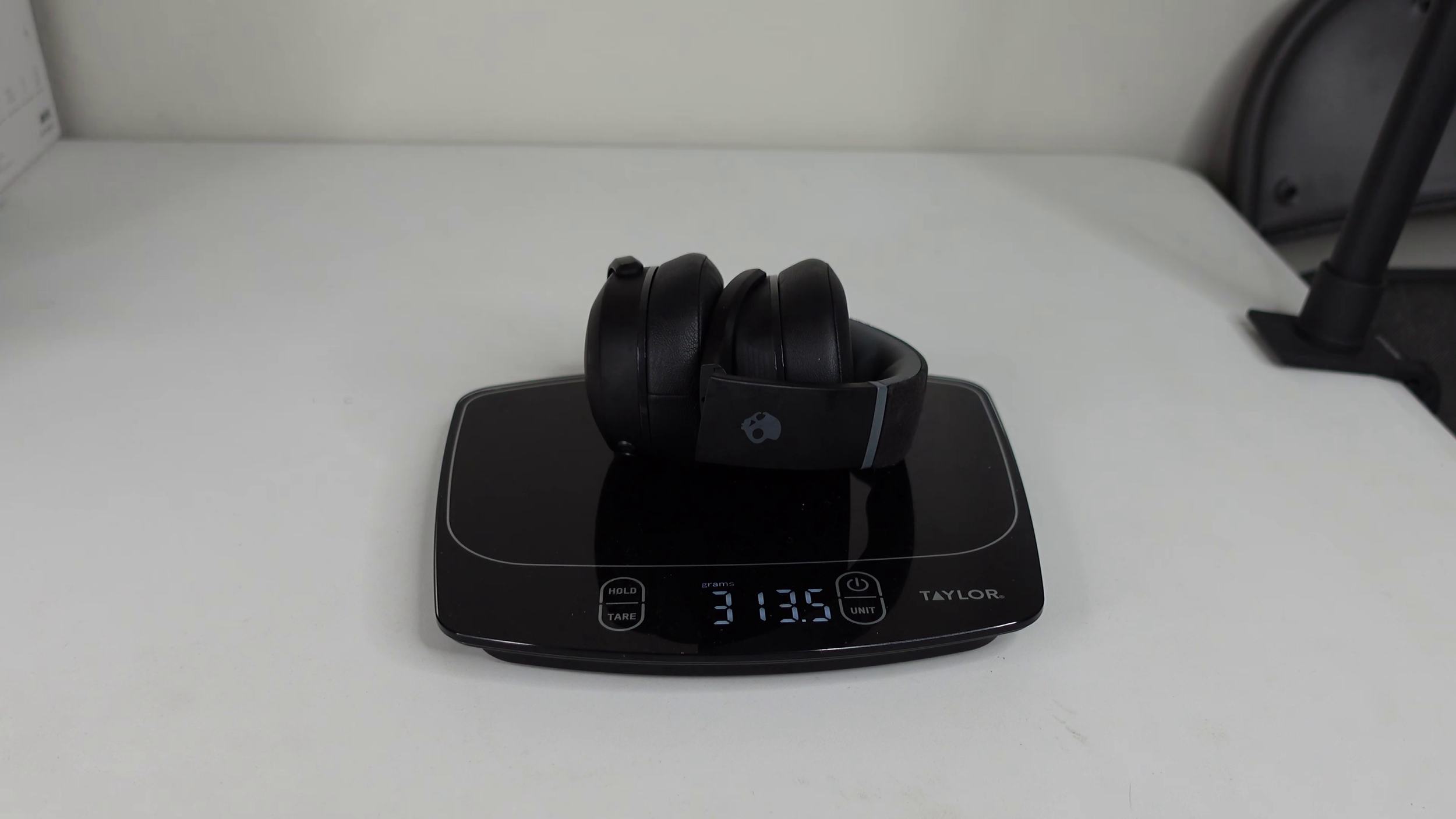
The Crusher Evo weighs 314 grams, while the Crusher ANC 2 comes in at 330 grams. For me, that’s simply too heavy for long sessions. For context, the Sony ULT Wear weighs 256 grams, and the Baseus Bass BH1 is even lighter at 235 grams.
The ANC 2 does have thicker padding, which makes it slightly more comfortable over time. Both use pleather ear pads, which I prefer. The ANC 2 has a cloth section at the top. The Evo uses more exposed plastic in that area, which isn’t the softest but isn’t terrible either.
Crusher Evo.
Crusher ANC 2.
Both headphones use a soft-touch plastic on the outside that feels great in the hand, but it’s a massive fingerprint magnet. Any skin oils and smudges show up easily, and minor scratches are effectively permanent.
In terms of durability, both headphones have proven themselves over years of use with no real damage outside of cosmetics.
The paint on my Crusher Evo has gotten warped.
Overall, comfort is about a B for both. They’re heavy, but well built, with the Evo being slightly lighter and the ANC 2 making up for its weight with thicker padding.
Verdict
The Crusher ANC 2 is the winner here. It has better driver tuning out of the box, deeper and wider bass extension, EQ control, and a noise cancelling microphone.
The Crusher Evo’s main advantage is that it’s slightly lighter and it hits harder at maximum Crusher levels.
Both headphones are easily Bass Arena approved.